
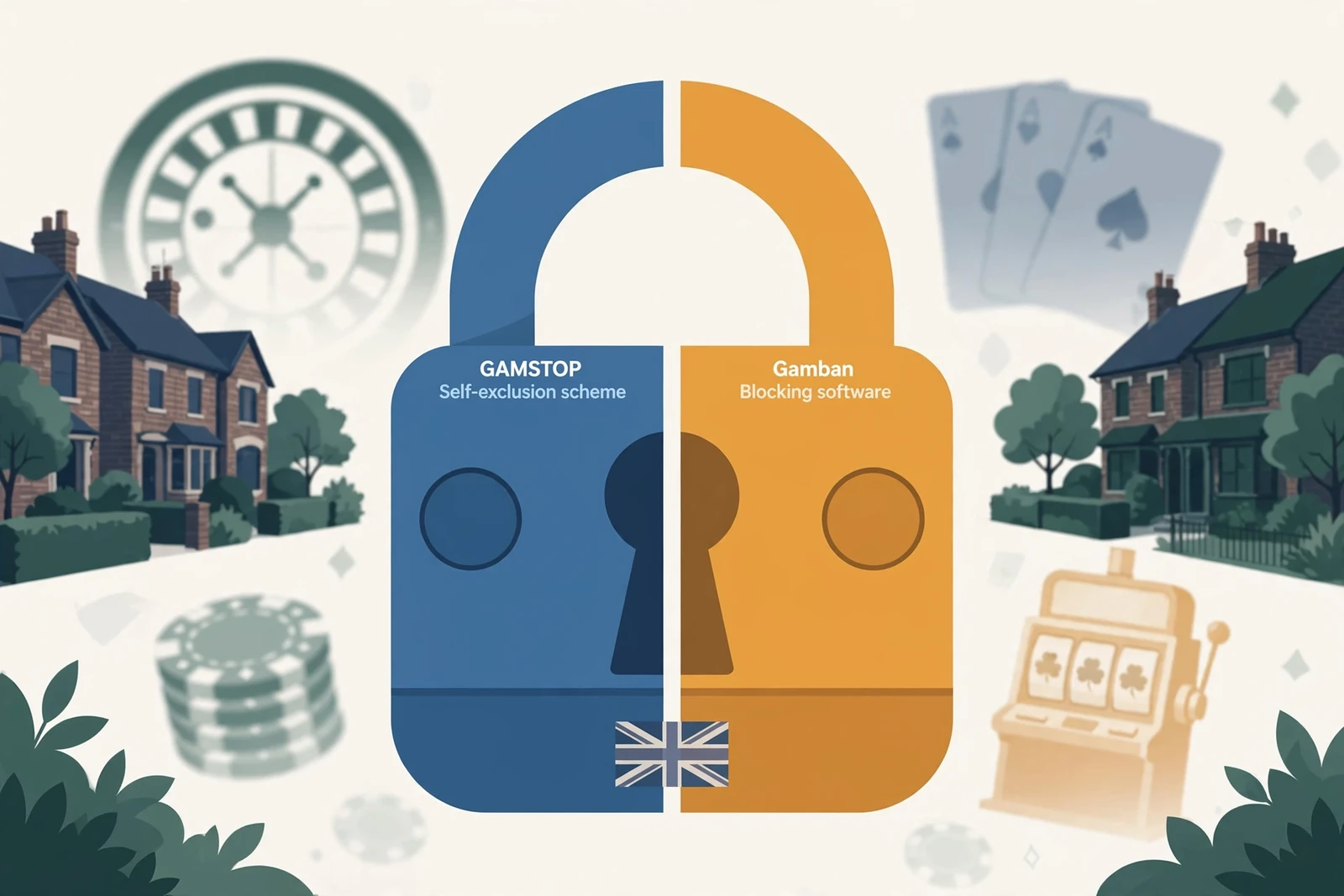
Gamban access blocking and GAMSTOP self-exclusion are separate systems, so one label cannot establish a site’s licensing or suitability.
What “Not on Gamban” Does—and Does Not—Tell You
“Not on Gamban” and “not covered by GAMSTOP” describe different things. The names are similar enough to invite confusion, but the services are not interchangeable. Gamban is a separate gambling-blocking service; GAMSTOP is Great Britain’s national online self-exclusion scheme. A statement about one does not, by itself, establish anything about the other.
That distinction matters when a casino describes itself as outside a blocking tool. The phrase may refer to whether a particular service blocks access to the site, but it does not prove that the site sits outside GAMSTOP. Nor does it establish that an operator is licensed, that a particular account can be opened, or that the site is appropriate for someone who has chosen to self-exclude. Those are separate questions, not different readings of the same label.
Two names, separate functions
GAMSTOP is a multi-operator scheme: a person who registers can exclude themselves from gambling with UK-licensed online casinos through a single scheme, rather than treating each casino as an isolated case. Its coverage concerns participating licensed gambling websites and apps. GAMSTOP is therefore about self-exclusion across operators, not simply whether a blocking product recognises a particular website.
If you’re looking at non-GamStop casinos in the UK, payout timing is one practical detail to check alongside your own preferences. This list gives a concise reference point on the payout speed provided for each operator.
1. Amunbet
Payout speed: 1-3 business days Amunbet lists a payout speed of 1–3 business days, a useful detail to consider when reviewing its payment arrangements.
2. Jetsetspins
Payout speed: 1-3 business days Jetsetspins lists a payout speed of 1–3 business days. This gives you a stated timeframe to keep in mind when considering withdrawals.
3. Dieselwin
Payout speed: 1-3 business days Dieselwin lists payouts as taking 1–3 business days, providing a clear stated timeframe for withdrawals.
4. WinBeast
Payout speed: 1-3 business days WinBeast lists a payout speed of 1–3 business days. That stated timeframe is the available detail to consider for withdrawals.
5. x3bet
Payout speed: 1-3 business days x3bet lists payouts within 1–3 business days, offering a specific timeframe to bear in mind when reviewing the operator.
6. Britsino
Payout speed: 1-3 business days Britsino lists a payout speed of 1–3 business days, giving readers a stated withdrawal timeframe to consider.
7. EvoSpin
Payout speed: 1-3 business days EvoSpin lists payouts as taking 1–3 business days. This is the available concrete detail about its payout timing.
8. Chanze
Payout speed: 1-3 business days Chanze lists a payout speed of 1–3 business days, a practical detail to note when considering withdrawal timing.
9. SpinFormula
Payout speed: 1-3 business days SpinFormula lists payouts within 1–3 business days. Readers can use this stated timeframe as one point of reference.
10. BeOnBet
Payout speed: 1-3 business days BeOnBet lists a payout speed of 1–3 business days, providing a stated withdrawal timeframe to consider.
Gamban is a separate service. A casino being described as “not on Gamban” refers to Gamban, not automatically to GAMSTOP. The phrase cannot be used as a reliable substitute for “not on GAMSTOP”, and the reverse is equally true. One label cannot be translated into the other without evidence that addresses both systems.
The distinction is more than branding. A site may be discussed in relation to a blocking tool, while GAMSTOP’s purpose is to apply a multi-operator self-exclusion across its participating licensed online gambling sites and apps. The two descriptions answer different questions. Treating them as synonyms collapses those questions and makes the resulting conclusion unreliable.
What the label does not establish
A claim that a casino is not blocked by Gamban is narrow. Even taken at face value, it says something only about the relationship between that site and that particular blocking service. It does not prove that the operator is outside the GAMSTOP scheme. It does not show that the operator has no UK licence, or that it has one. It does not tell whether an app and a website are treated alike by a blocking product. Nor does the label settle the status of every page, brand, or account associated with a business.
The wording may also be used loosely in casino material. “Not on Gamban” can sound like a formal status, but the phrase alone does not identify what was checked, when it was checked, or which version of a site or app the statement refers to. Without that detail, it should be read as a claim about Gamban—not as a certificate covering other systems or regulatory questions.
Non-GamStop Curacao Casino Sites: UK Rules Explained
This is why “casinos that are not on Gamban” is not a meaningful category for every decision a player might need to make. It groups sites by one asserted relationship to one service. It does not sort them by GAMSTOP coverage, licensing, safer-gambling measures, or suitability for a person’s circumstances. A category name cannot supply those missing distinctions.
The same caution applies to online casinos not on Gamban, casino sites not on Gamban, and casino apps not on Gamban. These are variations of one claim, not three independent assurances. Changing the noun from casino to app does not make the information more complete. The central question remains: what exactly is being claimed about Gamban, and is there separate information about GAMSTOP?
A site’s visibility is not a self-exclusion status
A person may encounter a site while using or considering a blocking service and infer that it is outside all exclusion arrangements. That inference does not follow. A site’s apparent accessibility through one tool cannot establish whether it is included in a separate scheme. Equally, the absence of a site from a particular description or list does not establish the operator’s position in another system.
GAMSTOP provides a route for players to ban themselves from gambling with UK-licensed online casinos. Its reach is multi-operator: it applies across participating licensed online gambling websites and apps. That framework is distinct from a site-by-site description involving Gamban. The word “participating” matters; the scheme’s coverage is not defined by a casino’s marketing phrase about a different service.
Attention: A site’s accessibility through one blocking tool does not establish whether it is included in a separate scheme like GAMSTOP.
This distinction also prevents a common category error: assuming that “not on Gamban” means “not self-excluded”. A player’s GAMSTOP status is not determined by whether a casino advertises itself as unaffected by Gamban. The two services have separate roles, so the phrase cannot be used to infer that a person’s GAMSTOP exclusion has ended, does not apply, or can be disregarded at a particular site.
Likewise, a search for non-Gamban online casinos does not resolve whether a named business is within GAMSTOP’s scope. “Non-Gamban” is not a synonym for “non-GAMSTOP”. It describes no more than a claimed relationship with Gamban unless further, independent details are provided. Any wider conclusion requires information about the relevant scheme and operator, not a change of wording.
“Best” is not a safety category
Labels such as “best casinos not on Gamban” or “best UK casinos not on Gamban” can make the category sound assessed and ranked. But the phrase “not on Gamban” supplies no basis for ranking a casino. It does not measure the quality of its terms, establish its regulatory status, or show whether it is covered by GAMSTOP. Adding “best” changes the sales language, not the underlying evidence.
The same applies to a date attached to the label. “Best casinos not on Gamban 2026” may suggest that the claim has been freshly checked, but the year alone does not say what was checked or whether GAMSTOP coverage was considered. A time label cannot convert one service’s status into another’s. Any recommendation based on that wording should therefore be treated as a separate claim requiring separate support.
There is no useful shortcut from Gamban status to suitability. A site’s relation to a blocking tool is not a measure of whether gambling there is appropriate for a person who has self-excluded. GAMSTOP exists as a separate multi-operator self-exclusion scheme, and a claim about Gamban cannot cancel or replace that distinction. In practical terms, “not on Gamban” is not a permission slip.
Non-GamStop European Casinos: What UK Players Should Know
Slots do not change the distinction
Searches for slots not on Gamban, UK slots not on Gamban, or online slots not on Gamban apply the same label to a particular type of gambling. They do not describe a separate exclusion framework. A slot game being offered on a casino site does not acquire a different GAMSTOP status from the operator merely because it is a game rather than a casino homepage. The wording still concerns the relation claimed between the site or product and Gamban.
“Best online slots not on Gamban” adds a ranking claim but does not answer the more basic questions. It does not establish whether the casino offering the game is included in GAMSTOP, whether the operator is licensed, or whether the game is suitable for someone who has self-excluded. Those questions cannot be answered by the phrase “not on Gamban”, whether it appears beside a casino name, app, or slot.
The clean reading is limited: Gamban and GAMSTOP are separate services; GAMSTOP is Great Britain’s national online self-exclusion scheme and allows players to exclude themselves from UK-licensed online casinos across participating operators. A claim that a site is not on Gamban does not establish that it is outside GAMSTOP, and it does not establish that using it is suitable after self-exclusion. The rest is a claim that needs its own evidence.
Where GAMSTOP Applies—and What Its Coverage Means
GAMSTOP is a multi-operator self-exclusion scheme for online gambling. Registration is intended to prevent access to existing gambling accounts and stop new accounts being opened with operators covered by the scheme. Its coverage is therefore broader than a request made to one casino: the exclusion applies across the participating online operators rather than only at the business where registration began.
For UK-licensed online gambling, participation is not an optional feature chosen by each casino. The Gambling Commission made GAMSTOP participation compulsory for online operators from 31 March 2020. As a result, regulated online casinos serving the UK must block customers who are registered with the scheme. The requirement applies across the licensed market, not just to a particular brand or group of websites.
British Casinos Not on GamStop: UK Rules Explained
The scope is online operator access
GAMSTOP covers participating licensed online gambling websites and apps. In practical terms, its purpose is to restrict a registered person’s access to gambling accounts across those platforms and prevent the creation of further accounts with covered operators. The scheme is multi-operator: a separate registration with every UK-licensed casino is not the mechanism on which its coverage depends.
That distinction matters when interpreting what a site’s status means. A casino does not become outside GAMSTOP merely because it is unfamiliar, uses a different brand name, or is not part of a particular operator group. The relevant point is whether it falls within the licensed online market required to participate. Since the obligation applies to UK-licensed operators, a change of brand does not remove the underlying participation requirement.
The scheme is also free to join. That describes the cost of GAMSTOP registration, not the price or terms of gambling services and not the quality of an operator. Cost and coverage are separate questions: the scheme’s registration charge is nil, while its function is to apply self-exclusion across covered accounts.
Trusted Casinos Not on GamStop UK: What to Know
GAMSTOP’s reach should be understood as a restriction on access to online gambling operators, rather than as a general statement about every website a person might encounter. Its role is tied to participating licensed gambling businesses. It does not turn every online casino into a covered operator simply because the casino can be viewed from the UK, nor does the appearance of a casino in a search result establish anything about its regulatory position.
A market-wide requirement, not a voluntary badge
The compulsory participation date gives the scheme a clear regulatory boundary. Since 31 March 2020, online operators licensed by the UK Gambling Commission have been required to participate. Every regulated online casino in the UK must therefore block a customer who has self-excluded through GAMSTOP. Compliance is a condition of operating in the regulated market, not an extra safeguard that a casino may advertise or withdraw at its discretion.
This makes the phrase “not covered by GAMSTOP” insufficient on its own to describe a casino’s standing. It could refer to a business outside the scheme’s participating licensed market; it does not mean that the business is another regulated UK casino with an optional exemption. Remote operators offering gambling to the British market must hold the relevant Gambling Commission licence, regardless of where the company is based. A casino outside the UK regulatory system is not made part of that system by accepting customers in the UK.
Since 31 March 2020, participation in GAMSTOP has been compulsory for all online operators licensed by the UK Gambling Commission.
The distinction is useful because coverage and legality are not synonyms. GAMSTOP’s compulsory reach follows the UK licensing framework for online operators. Where a site is outside that framework, the absence of GAMSTOP coverage is not evidence that the site has passed UK regulatory checks. Nor does it make the site a suitable substitute for a covered casino. A name, app, or account page cannot override the operator’s licensing position.
There is also no sound basis for treating non-coverage as a technical loophole within the UK-licensed market. A regulated casino cannot opt out of GAMSTOP while remaining subject to the participation requirement. If a site is genuinely outside the scheme, that fact points away from the licensed coverage boundary; it does not establish that a UK-licensed casino has a lawful exemption.
What registration changes across covered accounts
Once a person is registered, GAMSTOP is meant to prevent access to current gambling accounts and the opening of new ones with covered online operators. That is the central consequence of its multi-operator design. The scope is not limited to the casino where a person first considered self-exclusion, and it is not restricted to one operator’s collection of brands.
The practical effect is broader than an account-level request sent to a single business, because the scheme operates across participating operators. Yet the boundary remains defined: GAMSTOP relates to online gambling businesses within its coverage. It should not be read as a guarantee that every gambling-related service or every site visible online will be blocked. The scheme’s stated purpose concerns covered gambling accounts and the operators that participate.
Non-UK-Regulated Casinos: Licensing and Player Risks
For a UK-licensed casino, the requirement is direct: a registered self-excluded customer must be blocked. For a casino outside the regulated UK market, GAMSTOP’s participation requirement does not create the same coverage. That difference is not an endorsement of the latter. It simply identifies where the UK-wide scheme’s regulatory reach applies.
The date also helps avoid a common misreading. The mandatory arrangement began on 31 March 2020; it was not a rule that each operator could choose to adopt later. A regulated online casino’s participation is part of the market-wide framework established from that point. Any description of a UK-licensed operator as “not part of GAMSTOP” conflicts with that requirement.
GAMSTOP coverage therefore answers a specific question: whether an online gambling operator is within the multi-operator self-exclusion system required for UK-licensed operators. It does not, by itself, describe the full regulatory status of a site outside that system, and it does not convert absence of coverage into a safety feature. The scheme’s value lies in its common reach across regulated online gambling accounts; its limit lies in the fact that this reach is tied to the operators required to participate.
Self-Exclusion Is Not a Filter to Work Around
Self-exclusion is a formal commitment to stop gambling with specified businesses for an agreed period. It is not merely an account setting or a request to pause one payment method: the person who enters the agreement remains responsible for not gambling during its term. The arrangement may cover a set period, commonly between six months and five years.
Risk of Breach
Opening an account with another casino to bypass a self-exclusion may breach the terms of the agreement and does not cancel existing commitments.
The businesses named in an exclusion are expected to refuse service to the person. They must also take reasonable measures to stop a self-excluded customer from gambling with them. Self-exclusion is a safeguard with obligations on both sides, not a transfer of all responsibility to the operator. Gambling businesses are required by law to offer a way to self-exclude; that requirement does not turn the agreement into permission to gamble somewhere else.
Opening an account with another casino to get around an exclusion is not an appropriate solution. A site that is not blocked by Gamban, or that is outside a particular self-exclusion route, does not cancel an existing commitment. Gambling at a non-GAMSTOP casino could breach the terms of a self-exclusion, depending on what the agreement covers. The absence of a technical block is not evidence that gambling is consistent with the exclusion.
The financial result also remains with the player. A regulator cannot refund money lost through gambling, including losses incurred after a person has chosen to gamble despite an exclusion. If an excluded business fails to follow its obligations, that is a separate issue from recovering gambling losses; it does not make a workaround a sound remedy.
The practical boundary is therefore wider than a single login. Where there is a risk of being tempted to gamble, the exclusion should cover the relevant places and services rather than leaving an obvious route open. A search for a casino without Gamban does not establish that using it is safe, permitted by the terms, or suitable for someone who has formally excluded themselves.
An exclusion is not a filter to defeat. Its purpose is to prevent gambling during the period agreed, while the business takes steps to enforce the restriction. Seeking another account shifts no part of that responsibility and may create further losses without resolving the original problem.
Anjouan Casino Licence UK: What It Means
What “GAMSTOP-Free” Can and Cannot Promise
“Free” has a narrow meaning when it refers to GAMSTOP: registering for the scheme does not cost the person who self-excludes. It does not describe the price of gambling, the terms attached to a casino account, or whether a gambling site is suitable for a particular person.
GAMSTOP prevents access to existing gambling accounts and the opening of new ones with online operators across the UK. The scheme’s no-cost registration is therefore a feature of the exclusion service, not a statement about a casino’s deposits, withdrawals, bonuses or other conditions. Those are separate matters and cannot be inferred from the word “free”.
The distinction also applies to labels such as “GAMSTOP-free casino”. The label describes a relationship to an exclusion scheme; it does not mean that the casino’s products or services are free. Nor does it establish that gambling there carries no financial cost. Any money deposited or wagered remains subject to the site’s terms and the outcome of play.
“Gamban-free” is a different phrase, but the same pricing caution applies: the word “free” alone does not set out what a site charges or what its terms require. A label is not a price schedule. It is also not evidence that using a site is appropriate for someone who has chosen to self-exclude.
The cost of joining GAMSTOP must be kept separate from the legal duty on gambling businesses. Gambling businesses are required to offer self-exclusion; that obligation does not depend on the customer paying to use GAMSTOP. Self-exclusion is a request for a company to stop a person betting with it for a specified period. GAMSTOP provides a route covering online gambling operators across the UK, while the no-cost aspect concerns registering with that scheme.
Safety & Licensing for UK Online Casinos
Accordingly, “GAMSTOP is free” answers one limited question: whether registration with the scheme has a charge. It does not establish that a casino is free to use, that its terms are favourable, or that its services are suitable. Those conclusions require separate information and cannot be drawn from the scheme’s price.
Assessing Non-GAMSTOP Sites Without a Best-of List
Calling a casino one of the best non-GAMSTOP casinos in the UK would require more than confirming that it is outside a particular blocking tool. That label does not establish the safeguards in place, the terms that apply to an account or whether the operator is authorised to serve customers in Britain. It is not a quality measure.
The practical assessment starts with the rules that apply to UK-licensed online gambling businesses. Age must be verified before a customer can deposit. A new customer must also be prompted to set a financial limit before making the first deposit, and account-level limit controls must be accessible. These are checkable safeguards, not promotional claims. A site’s appearance, game selection or welcome offer cannot substitute for them.
Safe Online Casinos in the UK: Licensing and Protection
The sequence matters. Age verification is required before funds enter the account; a prompt to set a financial limit belongs before the first deposit. Limit controls should then be available through the account, rather than treated as a one-off sign-up formality. If those protections cannot be established, a favourable rating would have little analytical value.
The phrase “non-GAMSTOP” does not tell a customer whether these requirements are met. Nor does it, by itself, show that a gambling business is licensed to serve the British market. Remote operators offering gambling to customers in Great Britain must hold the relevant Gambling Commission licence. A description used in marketing cannot replace that regulatory status.
There is no sound basis for treating non-GAMSTOP casinos as a single ranked category. Operators may differ in licensing status, account terms and the controls they make available; a label alone does not demonstrate that those differences have been assessed. Naming a site “best” without establishing the relevant protections turns a judgement into an endorsement.
Self-exclusion is also a material part of the assessment. Gambling businesses must take reasonable steps to prevent a person who has excluded themselves from gambling with them. A site that is outside a blocking tool should not therefore be assumed to be suitable for someone who has self-excluded. The absence of a block is not evidence that gambling there is safe or appropriate.
For a comparison to mean anything, it must be based on identifiable conditions: licensing, verification before deposits, the financial-limit prompt and accessible account controls. Without those checks, a best-of list would rank presentation rather than protection. A cautious assessment leaves the “best” label unused until the safeguards can be established.
Non-GAMSTOP Slots: The Rules Still Apply
The label attached to a slot site does not determine which game rules apply. In Britain, online slot requirements are tied to the operator’s regulatory status, not to whether a particular game is described as a non-GAMSTOP slot. A site outside the UK regulatory system is not made compliant with British rules simply because it offers familiar games or displays similar controls.
Do
- Verify age before depositing
- Prompt for financial limits before first deposit
- Provide accessible account-level controls
Don’t
- Use autoplay for online slots
- Allow spins shorter than 2.5 seconds
- Exceed maximum stake limits (£5 for 25+, £2 for 18-24)
For operators licensed by the UK Gambling Commission, online slots must follow requirements intended to constrain how play is delivered. Autoplay is banned: a player cannot set a slot to run successive spins automatically. Each spin must also last at least 2.5 seconds. These rules apply to online slots offered by UK-licensed operators; they do not establish that a site outside that system follows the same standards.
What the slot rules change
Without autoplay, each spin requires a separate decision. The rule does not set a spending cap for an individual player, make a game profitable, or prevent losses. A spin can still use the selected stake and produce a loss; the minimum duration only limits how quickly spins can be completed.
The 2.5-second minimum also does not mean that a session has a fixed duration. It sets a floor for the time taken by each spin, not a limit on how long an account can remain open. Nor does it alter the game’s outcome. The practical distinction is between the pace at which a licensed slot can be played and the financial result of playing it. Those are separate matters.
Stake limits are a separate part of the rules. For online slots, the maximum stake per game cycle is £5 for customers aged 25 and over, and £2 for customers aged 18 to 24. The £5 limit for all adults took effect on 9 April 2025. These limits concern the stake for a game cycle; they do not guarantee that a player will lose no more than that amount, since repeated play can involve further stakes.
Site status is not a game feature
A slot’s title, graphics or provider do not show whether the operator is licensed in Britain. Nor does a site’s claim that it offers slots without Gamban establish that it uses the British controls. Gamban is a blocking tool; its status does not certify a casino’s licence or demonstrate that a slot meets UK requirements.
Malta MGA-Licensed Online Casinos in the UK
A UK-licensed operator must participate in GAMSTOP. Participation became compulsory for online operators from 31 March 2020. As a result, an operator’s offering of UK-regulated gambling cannot be treated as both compliant with the British system and a route around a GAMSTOP exclusion. A website operating outside that system may be accessible, but accessibility is not evidence of equivalent safeguards or a lawful basis for serving British customers.
This distinction matters when a person has self-excluded. A slot’s compliance with autoplay, spin-duration or stake rules would not cancel the exclusion or make a different account an appropriate workaround. Playing at a non-GAMSTOP casino could breach the terms of a self-exclusion agreement. The game controls and the exclusion are different controls: one governs the operation of a licensed slot, while the other records a decision not to gamble.
Check the calculation, not the label
For a licensed slot, the stake limit sets the maximum amount that can be committed to one game cycle, while the spin-duration rule sets a minimum pace. Neither figure predicts the total cost of a session. The total depends on the number of game cycles and the stakes used, and the ban on autoplay does not prevent a person from choosing to continue manually.
Likewise, “no Gamban slots” is not a category that identifies a different class of game. A slot does not acquire a distinct regulatory status because a blocking product does not prevent access to the website offering it. The relevant questions are whether the operator is licensed to serve the British market and whether the player is subject to an active exclusion—not whether a game can be reached through a particular device or account.
The regulatory boundary remains decisive. Remote operators offering real-money gambling to customers in Great Britain must hold the relevant UK Gambling Commission licence. Offshore sites fall outside that UKGC system, so British slot rules should not be assumed to govern their products. That does not make such sites a suitable substitute for a licensed operator, and it does not remove the consequences of gambling while self-excluded.
Non-UK Regulated Casinos and UK Gambling Rules
The GAMSTOP Process and Account-Level Exclusion
How does self-exclusion work?
You register with a gambling business or scheme, confirm your identity, and choose an exclusion period. The businesses covered by the exclusion must refuse service; online operators must close your account, return its funds, and remove your details from marketing databases.
How do I return from self-exclusion?
For GAMSTOP, contact the scheme directly to request removal. A 24-hour cooling-off period applies, during which you can cancel the request; after removal, operators may take another 24 to 48 hours to update your status.
How does GAMSTOP benefit me?
GAMSTOP lets you exclude yourself from participating UK-licensed online gambling websites and apps with one free registration, rather than contacting each operator separately. It blocks access to existing accounts and prevents you from opening new ones for your chosen fixed period.
How long does it take for GAMSTOP to become active after sign-up?
The 24-hour cooling-off period starts once your identity has been verified, and your exclusion remains active throughout that period.
Material created by the team Lizaro