
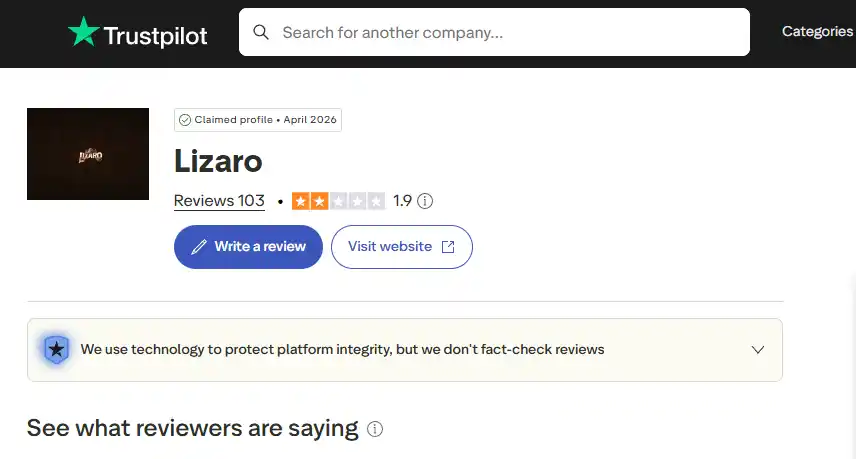
Current public review and complaint sources show a material concentration of Lizaro reports about withdrawal delays, account handling and KYC friction. At the publication check, the lizaro.com Trustpilot profile had a strongly negative review distribution and multiple withdrawal-related complaints, while Casino Guru records reviewed for this page included both resolved and unresolved withdrawal cases and a verification-related dispute. These reports are evidence of recurring themes, not proof that every allegation is true or that every player has the same outcome.
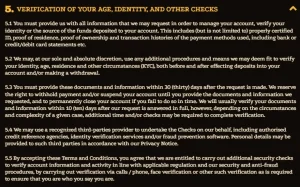
The most useful way to read complaints is to compare them with the operator’s own written process. Lizaro’s current terms say withdrawal requests are worked through by the financial department within three business days when conditions and checks are complete, while KYC is usually reviewed within 10 days after a complete response, with extra checks able to extend that period.
Reputation snapshot
Withdrawal delays are the clearest recurring complaint theme
- Trustpilot: the current profile shows a strongly negative distribution and repeated withdrawal-related criticism.
- Casino Guru: complaint records reviewed include withdrawal delays, verification friction and mixed case outcomes.
- Official withdrawal rule: Lizaro says requests are worked through within three business days when other conditions and checks are complete.
- Official KYC rule: verification is usually completed within 10 days after a request is answered in full, with additional checks able to take longer.
- Evidence limit: a complaint can show that someone reported a problem; it does not by itself prove the allegation or establish a universal operating pattern.
How much weight should you give a Lizaro complaint?
A complaint is most useful when it provides a dated sequence of events, identifies the issue clearly and has an outcome recorded by an independent platform. Even then, it remains a report by a particular user unless documents, operator correspondence or another primary source corroborate the underlying allegation.
That is why this page does not turn search phrases such as “Lizaro scam” into an editorial conclusion. The useful question is narrower: do separate sources show the same type of friction often enough to deserve attention, and how does that compare with Lizaro’s published terms? Repeated withdrawal complaints can be a meaningful reputation signal even when individual cases cannot be independently proved.
Star ratings are also secondary evidence. They can summarise sentiment, but they do not tell you whether one complaint was caused by missing KYC, an operator delay, a payment-provider issue, a bonus dispute or a customer abandoning the complaint process. The detailed record matters more than the headline score.
Complaint pattern table: issue, source and evidential weight
| Issue | Current source signal | Official-rule context | Evidential weight |
|---|---|---|---|
| Withdrawal delay | Repeated on Trustpilot and in several Casino Guru complaint records. | Terms say the financial department works requests within three business days when conditions and checks are complete. | Medium as a pattern; low for proving any single allegation without documents. |
| KYC or document friction | Some complaint records describe repeated or prolonged verification requests. | Terms allow identity, residence, payment and source-of-funds checks and usually target 10 days after a complete response. | Medium as a recurring theme; case-specific causes remain uncertain. |
| Support frustration | Negative reviews often describe repetitive or unsatisfactory support interactions. | Lizaro documents 24/7 support, but does not publish a guaranteed resolution time for every case. | Low to medium; service quality is subjective and varies by case. |
| Account closure or cancellation | Some complaint records involve cancelled withdrawals or account actions. | Terms reserve broad powers for checks, fraud controls and account restrictions. | Low unless the case record includes enough evidence to establish why the action occurred. |
What the current Trustpilot profile tells you
The lizaro.com Trustpilot profile was refreshed immediately before generation. At access time it showed 102 reviews, a TrustScore of 1.9 out of 5 and a 75 percent one-star share. The visible review stream included multiple users complaining about slow or pending withdrawals, alongside a smaller number of positive experiences.
Those numbers are useful only as a dated sentiment snapshot. Trustpilot itself labels reviews as the opinions of individual users. A low score therefore supports the conclusion that Lizaro has a significant reputation problem on that platform, but it does not prove that every payment is delayed or that every negative account is accurate.
For a UK reader, another complication is that some GB-tagged reviews describe actual deposits or withdrawals. Those reports conflict with Lizaro’s current official terms, which now list the United Kingdom as an excluded jurisdiction. The Lizaro KYC checks page and the broader Lizaro safety review keep those operational reports separate from current eligibility and regulatory evidence.
Casino Guru shows both resolved and unresolved cases
The Casino Guru records reviewed for this page are useful because they attach dates and case outcomes to individual complaints. They do not all point in the same direction. A withdrawal complaint submitted on 14 April 2026 was marked resolved on 21 April, and another submitted on 2 July was marked resolved on 5 July. By contrast, a complaint submitted on 12 May was marked unresolved on 12 June after the platform recorded that the matter had not been resolved through its process.
This mix is important. If only unresolved cases were selected, the page would exaggerate the evidence. If only resolved cases were selected, it would hide a material risk signal. The fair reading is that Lizaro has generated enough withdrawal complaints for a recurring pattern to be visible, while the case history also shows that some disputes have ended with the player confirming resolution.
A separate 2026 complaint record describes prolonged document and verification friction. That supports KYC as another theme worth monitoring, but it still does not establish why every verification delay happens. The operator’s terms allow additional checks and make the normal 10-day target conditional on the request having been answered in full.
How the three-business-day withdrawal wording should be read
Lizaro’s current terms state that withdrawal requests are worked through by the financial department within three business days after the request is made, or within three business days after the last withdrawal request was paid, provided other conditions are met and checks are completed. The terms also say further payment-system delays after the financial department has worked through the request are not the company’s responsibility.
That wording is not a promise that every customer receives funds in three business days. It describes an internal processing stage and makes that stage conditional on checks and other terms. A complaint that a withdrawal remained pending for longer than expected is therefore relevant to reputation, but analysing whether it breached the written terms requires the full case facts: when the request was submitted, whether KYC was complete, whether another withdrawal was pending and what status the operator had actually assigned.
The dedicated Lizaro withdrawals page keeps the exact withdrawal limits, pending-request cap and processing clauses together. That is a better place to judge the mechanics than relying on a reviewer’s memory of the terms.
KYC complaints need a different evidence test
Lizaro can request identity, residence, payment-method ownership, transaction-history and source-of-funds information. Customers are given 30 days to provide requested documents, and the terms say review is usually completed within 10 days after the request is answered in full. Additional time and checks can be required depending on complexity.
That creates two ways for a KYC complaint to be misunderstood. A player may count from the first upload even though the operator says the response was incomplete, or the operator may continue asking for documents long after the customer believes the request was satisfied. Without the correspondence, an outside reviewer often cannot establish which version is correct.
For that reason, the strongest complaint evidence includes the request date, the date a complete response was supplied, any follow-up request and the final outcome. A vague statement that “verification took too long” is a weaker signal than a dated case showing repeated requests after the operator acknowledged receiving the requested evidence.
Resolved, unresolved and closed are different outcomes
Complaint-platform labels need to be read literally. A resolved case means the platform recorded a resolution or the player confirmed that the issue had been addressed. An unresolved case means the dispute remained open in substance at the end of that process. A closed case can mean something different again, including that the player stopped responding before the platform could investigate further.
Those distinctions prevent a common analytical error: treating every complaint listing as evidence that the casino refused to pay. Some records end in payment or another resolution, while others remain unresolved for reasons that can include lack of operator cooperation or incomplete evidence. The correct reputation conclusion is about pattern and uncertainty, not a claim that every case had the same cause or result.
What a UK reader should do with this reputation evidence
For UK readers, the complaints are not the first decision gate. Lizaro’s current terms independently exclude United Kingdom residents from opening accounts or adding funds. The Lizaro UK review therefore treats complaints as an additional trust signal rather than as the reason a UK resident should or should not register.
If you are assessing an existing historical dispute, preserve the timeline: withdrawal request date, KYC completion, operator responses, payment status and any complaint-platform outcome. That evidence is far more useful than a star rating. It also makes it easier to compare the case with the written three-business-day processing language and the KYC clauses without assuming that one side’s summary is complete.
Current reputation sources checked for this page
- Trustpilot Lizaro profile – aggregate user-review and complaint sentiment.
- Casino Guru unresolved withdrawal case – case-status example.
- Casino Guru resolved withdrawal case – resolved case example.
- Lizaro General Terms and Conditions – withdrawal and KYC rules used as the contractual comparison point.
How to interpret Lizaro complaint patterns without overclaiming
The current evidence supports a measured conclusion: withdrawal delays are a recurring Lizaro complaint theme across more than one public source, verification friction also appears in complaint records, and the case history includes both resolved and unresolved outcomes. That is enough to treat reputation as a material risk factor, but not enough to claim that Lizaro never pays, that every account faces the same problem or that every allegation is proven. The most reliable approach is to separate what the licence record proves, what the official terms promise about processing and KYC, and what individual players report happened to them. Those three evidence types answer different questions, and keeping them separate produces a more useful risk assessment than any single star rating or accusation.
Lizaro UK Guide is an independent editorial information resource and is not the casino operator.
Material created by the team Lizaro