

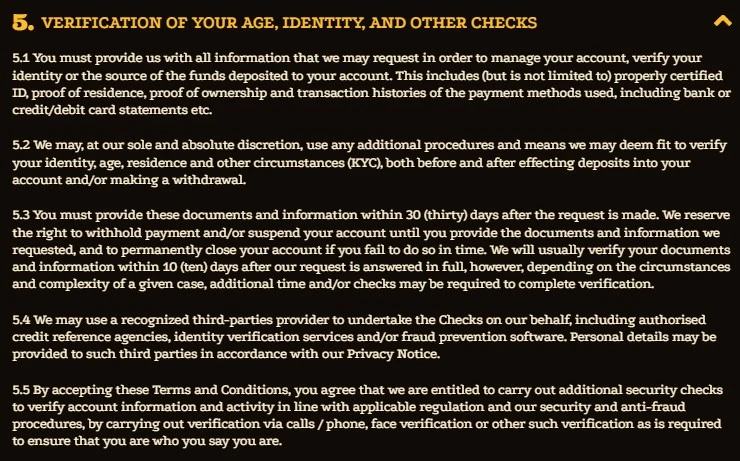
Lizaro’s current terms say the operator can request identity, age, residence, payment-ownership and source-of-funds information before or after deposits and withdrawals. The terms specifically mention certified ID, proof of residence, payment ownership and transaction histories, including bank or card statements. Requested information must be supplied within 30 days. Once a request has been answered in full, Lizaro says verification is usually completed within 10 days, although the same clause allows extra time or additional checks when a case is more complex.
Those are the current contractual timings, not a promise that every check finishes on a fixed day. Verification can also interact with withdrawals because the terms allow payments to be withheld or postponed while required checks remain incomplete. UK residents should note that Lizaro’s separate current terms exclude the United Kingdom from account opening and funding, so this page explains the KYC framework rather than a UK sign-up route.
Current verification framework
The key Lizaro KYC timings are 30 days to supply information and usually 10 days for review after a complete response
- Evidence: ID, residence, payment ownership, transaction history and source-of-funds information can be requested.
- When checks can happen: before or after deposits and before or during a withdrawal review.
- Your response deadline: requested documents and information must be supplied within 30 days.
- Usual review target: the terms say verification is usually completed within 10 days after the request has been answered in full.
- Complex cases: additional time or additional security checks can be required.
What evidence Lizaro can request
The official terms use a broad verification power rather than a short universal checklist. They say customers must provide information needed to manage the account, verify identity or establish the source of deposited funds. The listed examples include properly certified identification, proof of residence, proof that the payment method belongs to the customer and transaction histories for the payment methods used.
The same section also allows Lizaro to verify age, residence and other circumstances using additional procedures. A later clause says extra security checks can include phone contact, face verification or other checks considered necessary under the operator’s security and anti-fraud procedures. That means a document request can vary by case. A reader should not assume that the examples below are the only evidence that can ever be requested.
| Evidence category | What the current terms support | Why it may matter |
|---|---|---|
| Identity | Properly certified ID is specifically listed. | Used to verify who controls the account and to support age and identity checks. |
| Residence | Proof of residence is specifically listed. | Can be relevant to residence checks and country eligibility. |
| Payment ownership | Proof of ownership of the payment methods used can be requested. | Links deposits and withdrawals to the account holder rather than a third party. |
| Transaction history | Bank or card statements and other payment histories are given as examples. | Can support payment tracing and source-of-funds review. |
| Source of funds | The terms expressly allow information to verify the source of deposited funds. | May be requested when the operator needs additional financial context. |
The verification timeline in the current terms
The timeline has two different clocks, and confusing them can make a delay look shorter or longer than the written terms actually say. The first clock is the customer’s deadline to provide what Lizaro asks for. Section 5.3 says the documents and information must be supplied within 30 days after the request is made.
The second clock begins only after the request has been answered in full. The same clause says Lizaro will usually verify the documents and information within 10 days after a complete response. It immediately adds that the circumstances and complexity of a case can require more time or more checks. The word “usually” matters: the clause gives a normal review target, not a guaranteed maximum processing time.
| Stage | Current term | Practical meaning |
|---|---|---|
| Request issued | Lizaro asks for documents or information. | The 30-day supply window begins from the request. |
| Customer response | All requested material must be supplied within 30 days. | An incomplete response may not start the normal review target. |
| Complete response | Verification is usually completed within 10 days after the request is answered in full. | This is the ordinary review target stated in the terms. |
| Additional checks | More time or checks may be needed depending on complexity. | There is no supported basis for promising every case will finish inside 10 days. |
How KYC can affect a Lizaro withdrawal
Verification and withdrawal processing are connected but not identical. Lizaro’s current withdrawal clause says financial department agents work through withdrawal requests within three business days, provided the other conditions are met and required checks are completed. Another clause expressly allows the operator to delay a withdrawal while it checks identity, account balance, source of funds or compliance with the terms.
That distinction is important. A three-business-day withdrawal process does not mean the money must always arrive within three business days, and a verification review is not automatically proof that a withdrawal has been rejected. The terms allow the payment process to pause while checks are outstanding. Our separate guide to Lizaro withdrawals keeps payment timing, limits and withdrawal conditions together rather than treating every delay as a KYC issue.
Section 5.3 also allows Lizaro to withhold payment or suspend an account until requested documents and information are provided. If the customer does not provide them within the 30-day period, the terms allow permanent account closure. That makes responding to a verification request a contractual requirement, not an optional profile update.
KYC is not the same as account eligibility
Passing identity checks does not create a right to use the service in a country that the current terms exclude. Lizaro’s country rules and its verification rules are separate. The Lizaro UK access page explains the official United Kingdom restriction, while the Lizaro registration rules cover the one-account framework and the public registration interface.
This separation also explains why residence evidence matters. KYC can verify that the information on an account matches a real person and location, but it does not override the operator’s country list. For a UK resident, the current published restriction remains the controlling access fact even if the KYC process itself is clearly described in the terms.
What to check if verification takes longer than expected
Because the terms tie the usual 10-day review target to a complete response, the first question is whether every requested item has actually been supplied in an acceptable form. If the operator asks for extra evidence after the first upload, the case may no longer fit the simplest timeline. The terms also reserve the right to use third-party identity services and additional security checks.
A useful record is therefore the request date, the date of each response, what categories of evidence were supplied and any follow-up request received. That record can help distinguish a missing-document problem from a review that has continued after the operator had a complete response. If the issue develops into a service dispute, the Lizaro complaints page explains how public complaint evidence should be assessed without treating individual allegations as established fact.
Why a complete response matters more than the first upload date
A common timing mistake is to count the verification period from the first document upload even when the operator has asked for several categories of information. Lizaro’s wording ties the usual 10-day review period to the point at which the request has been answered in full. If a proof-of-address file is missing, a payment-ownership question is still open or a follow-up source-of-funds request remains unanswered, the published wording does not support treating the first upload as the start of a guaranteed 10-day deadline.
For record-keeping, the most useful evidence is therefore a complete sequence: the original request, every item supplied, any rejection or replacement request, the date the operator confirmed it had everything required and subsequent messages about the review. That creates a clearer basis for assessing whether a case is still in verification or has moved into a wider payment or service dispute. The Lizaro UK review places that process alongside licensing, access and support evidence so KYC is not judged in isolation.
Primary source used for this KYC check
- Lizaro General Terms and Conditions – Version 1.12, last updated 19 August 2026; Sections 5 and 6 cover verification and its interaction with withdrawals.
How Lizaro verification can affect access to your balance
Lizaro’s current terms give KYC a direct role in whether withdrawals can proceed. The operator can request identity, residence, payment and source-of-funds evidence, requires requested information within 30 days and says review is usually completed within 10 days after a complete response, with longer checks possible in more complex cases. Because withdrawals can be postponed until verification is complete, the most useful timeline is not simply “withdrawal requested to money received” but “verification request to complete response to review outcome to payment processing”. That sequence explains why a KYC hold and a withdrawal-processing target need to be read together.
Lizaro UK Guide is an independent editorial information resource and is not the casino operator.
Material created by the team Lizaro