
Live blackjack tables differ in pace, stakes and connection demands, while rules and bonus terms also affect how a session plays out.
What Makes a Blackjack Table Worth Comparing
A live blackjack table is worth comparing on its terms, not on a broad label such as “best”. The useful question is whether its pace, starting stake and connection demands fit the intended session. A table can be available and still be a poor match if its minimum is too high, its rounds move too slowly, or the stream cannot be maintained reliably.
Pace is a practical cost. Live games run more slowly than digital versions, so a session takes longer to produce the same number of decisions. That may suit a player who prefers a measured rhythm; it may frustrate someone expecting rapid rounds. The difference matters when setting a budget: a slower table does not make each stake safer, but it changes how quickly decisions arrive. Any comparison should therefore distinguish the speed of play from the size of the stake.
A stable internet connection is a requirement, not an optional extra. Interruptions can affect the continuity of a live session, while a weak connection can make the experience difficult to follow. The comparison is not simply about whether a table opens on a device. It is whether the connection can sustain the live format without repeated pauses. Where connection quality is uncertain, a digital version may be the more practical choice; live play adds a dependency that a fully digital game does not have in the same way.
Choosing a live blackjack casino involves more than the game itself, so it is worth checking practical details such as how long withdrawals may take. This list gives a concise reference point for UK players looking at live blackjack options in 2026.
1. Amunbet
Payout speed: 1-3 business days Amunbet lists a payout speed of 1–3 business days, a useful detail to consider when weighing up a live blackjack option.
2. Jetsetspins
Payout speed: 1-3 business days Jetsetspins lists a payout speed of 1–3 business days. This provides a stated timeframe to factor into your choice.
3. Dieselwin
Payout speed: 1-3 business days Dieselwin lists payouts as taking 1–3 business days, offering a clear withdrawal timeframe for prospective players to consider.
4. WinBeast
Payout speed: 1-3 business days WinBeast lists a payout speed of 1–3 business days. That is the available practical detail to bear in mind when considering it.
5. x3bet
Payout speed: 1-3 business days x3bet lists a payout speed of 1–3 business days, giving players a stated timeframe to consider alongside their live blackjack preferences.
6. Britsino
Payout speed: 1-3 business days Britsino lists payouts as taking 1–3 business days. This stated timeframe may be useful when considering the operator for live blackjack.
7. EvoSpin
Payout speed: 1-3 business days EvoSpin lists a payout speed of 1–3 business days, providing a withdrawal detail to keep in mind when assessing its suitability.
8. Chanze
Payout speed: 1-3 business days Chanze lists a payout speed of 1–3 business days. This gives players a stated withdrawal timeframe to factor into their decision.
9. SpinFormula
Payout speed: 1-3 business days SpinFormula lists payouts as taking 1–3 business days, a practical detail for players considering its live blackjack offering.
10. BeOnBet
Payout speed: 1-3 business days BeOnBet lists a payout speed of 1–3 business days. This is the available withdrawal detail to consider when looking at the operator.
Starting limits need equal scrutiny. A low minimum gives more room to keep individual stakes modest; a higher one raises the cost of entry before any other table conditions are considered. Blackjack tables often have higher starting limits than live roulette or baccarat, but that is a broad comparison rather than a guarantee about every table. One specialist comparison review reported roulette and baccarat openings around 20p and higher starting limits for blackjack. That is a dated, source-specific observation, not a dependable current price list. The actual figure has to be checked on the table itself.
A headline minimum is only one part of the stake range. A table may permit a low opening stake but have a maximum that does not suit a particular budget, or offer several tables with different limits. The relevant comparison is between the available range and the amount set aside for the session. A table should not be treated as affordable merely because its lowest listed stake is technically reachable. The budget has to cover the intended play without relying on larger stakes later.
Table information should be read as a set of conditions rather than marketing. Check the stated minimum and maximum, and review the rules and paytable before playing. Those details establish what the table allows and how its terms apply; a general claim that a casino offers blackjack does not answer either question. If the table’s information is unclear, there is no sound basis for comparing its cost with another table.
Live Dream Catcher Casino UK: What to Check
The strongest comparison is therefore specific and limited: one table’s pace against the time available, its connection demands against the quality of the connection, and its limits against a fixed budget. A broad ranking cannot make those personal constraints disappear. Nor does a lower starting stake by itself make a table better; it is useful only if the other terms also fit.
For UK players, live blackjack belongs within a regulated online casino setting: remote operators serving the British market must hold the relevant Gambling Commission licence. That establishes the legal framework for the operator, but it does not make every table’s limits or conditions suitable. Those remain separate matters to assess.
A sensible comparison records the table terms before play and keeps the session within a predetermined budget. Past results do not alter the value of the stated limits, and a staking system cannot remove the house edge. The point is not to identify a table that promises a return; no table can be judged on that basis. It is to establish the cost and practical conditions of play before committing money. This is entertainment information, not gambling advice.
How Live Blackjack Is Dealt
A live dealer blackjack game is a streamed table rather than a software animation standing in for a dealer. A camera carries the action from a studio in real time, where a human dealer handles the cards. The screen is therefore showing a physical table and an actual deal as it happens, not a sequence generated solely by the game interface.
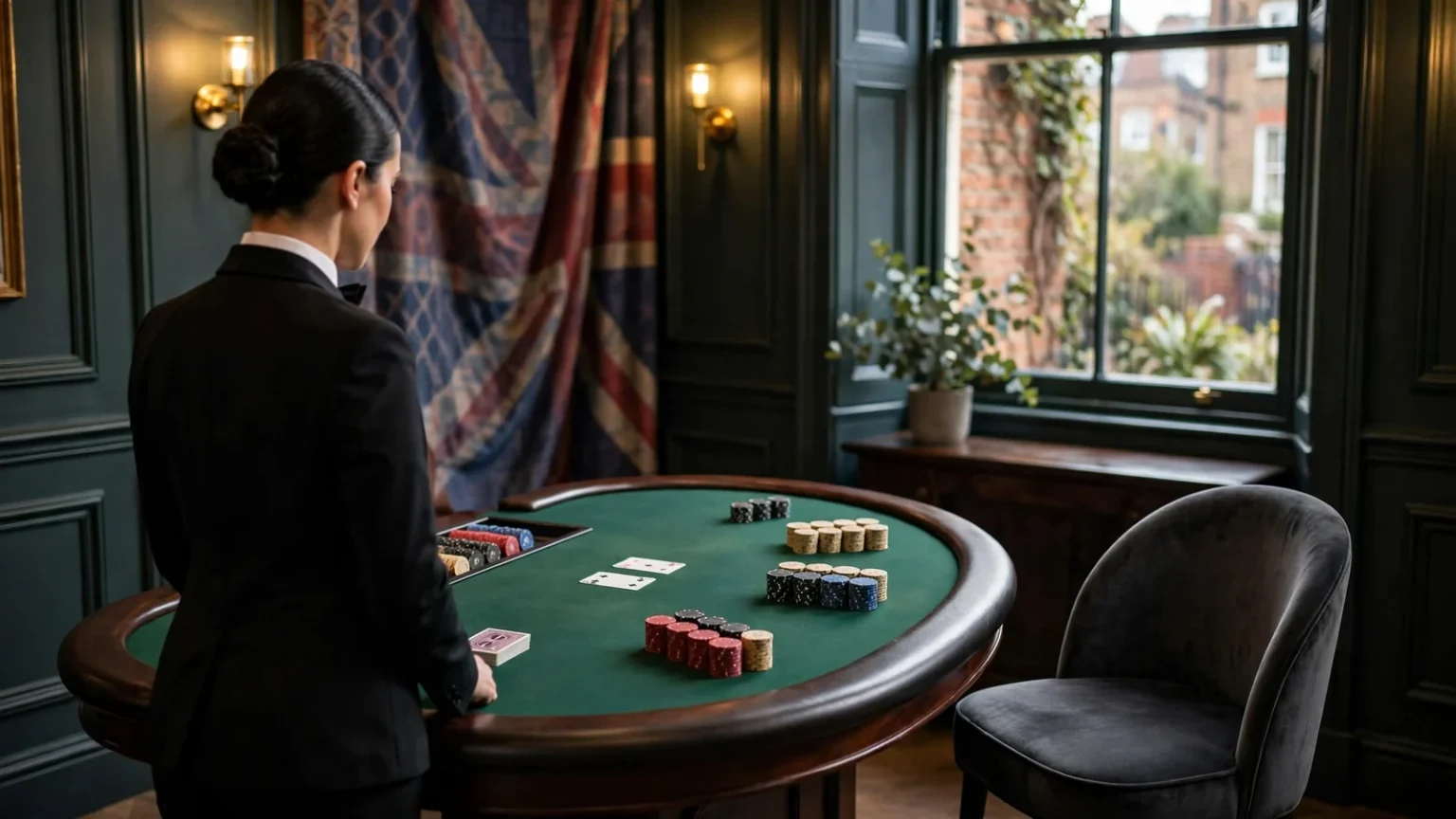
In a live dealer blackjack casino, the screen presents a real dealer and physical cards, while the online interface provides the controls for remote participation.
The dealer is visible throughout the broadcast and manages the table in view of the players. Cards are taken from a standard deck and dealt by hand. That distinction is central to the format: the screen presents a real dealer and physical cards, while the online interface supplies the means to join the game remotely. The experience combines a studio feed with controls for placing bets; it is not simply a video watched without participation.
How the screen and table work together
The live feed and the betting interface serve different purposes. The video shows the dealer and the table, while the interface records the player’s choices and sends them to the game. A bet is placed on screen, but the cards themselves remain part of the studio’s physical game. The layout may put the controls beside or over the video, but the underlying arrangement is the same: a real-time broadcast paired with an online method of taking part.
Timing is part of that arrangement. The dealer conducts the game in the studio, and players interact through the interface as the broadcast continues. This differs from a fully digital blackjack game, where the cards and dealing are represented by software rather than shown being handled by a person. In a live dealer blackjack casino, the camera gives the table a visible point of reference: the cards are dealt in front of the dealer, and the dealer’s actions can be watched as they occur.
French Roulette Online Casinos in the UK: Rules & Bets
The camera is not just decoration. It is the connection between the remote player and the physical table. A player can see the dealer, the cards and the progression of the deal, while the interface indicates when participation is available. The broadcast and controls work together, but they do not turn the studio into a private game; the dealer is running a shared table for those connected to it.
Interaction through the broadcast
Some live blackjack tables include chat. Where available, it can be used to communicate with the dealer or other players at the table. Its presence depends on the game, so it should not be treated as a standard feature of every table. Chat adds a social channel to the stream; it does not alter the fact that cards are dealt physically or that bets are submitted through the screen.
This interaction is more limited than being seated at a casino table. The dealer is seen and can be addressed through the available chat function, but participation still takes place remotely. The player does not handle cards or speak across a physical table. The studio feed supplies visibility, and the interface supplies the channel for actions and, where enabled, messages.
An online live dealer blackjack casino therefore joins three elements: a studio broadcast in real time, a human dealer handling a standard deck, and an on-screen interface for taking part. Chat may add communication with the dealer and other players. These are the practical features that define the live format; the video shows the physical game, while the screen translates remote participation into table actions.
Live Dealer Format
- Real-time studio broadcast
- Human dealer handling physical cards
- On-screen interface for betting
- Optional chat for communication
Blackjack Sites: Licensing and Table Information
A site’s licence is a threshold condition, not a verdict on its blackjack offer. In the UK, a live dealer casino may operate legally only if it holds the relevant UK Gambling Commission licence. Remote operators selling gambling to customers in Great Britain must hold a Commission licence regardless of where the business is based. A site’s location, branding or presentation does not replace that requirement.
This makes licensing status a practical first check when assessing blackjack casino sites. The licence establishes that the operator is within the UK regulatory system for the gambling it offers. It does not establish that every table has the same terms, that a particular game suits a given budget, or that any session will produce a profit. Those are separate questions, and the table information needs to answer them.
A clear operator should identify its licensing position and make the relevant details accessible. If that information is absent or difficult to locate, the gap matters: the site’s claims about its offer are not a substitute for an identifiable UK licence. A licence also should not be treated as an endorsement of a site’s value. Regulatory status and commercial terms belong in separate columns of any comparison.
The table page is the next source of decision-useful information. It should set out the conditions attached to the specific blackjack table, including its limits and rules. General statements that a casino offers blackjack online say little about which tables are available or whether their terms are suitable. A table listing can vary within one site, so the relevant details are those displayed for the particular game, not a broad claim on a landing page.
Crazy Time Live Casino Game Show in the UK
Rules and payout information also deserve attention before a table is chosen. Differences in table conditions can affect how a hand is settled and what a winning outcome returns. Reading the rules and paytable is therefore part of evaluating the offer, not administrative fine print. If the relevant terms are missing, unclear or inconsistent across the site, there is no sound basis for assuming the more favourable interpretation.
For blackjack online casino sites, the useful comparison is consequently layered: first establish that the operator is licensed for the UK market, then inspect the information attached to each table. The first check concerns whether the operator is legally authorised to offer the service. The second concerns the actual conditions of play. Neither check replaces the other.
Labels such as “best” or “top” do not resolve either issue. A prominent position in a list cannot establish licensing status, and a large selection does not demonstrate that table terms are transparent. A concise review of a site’s licence information, table rules, paytable and stated limits is more informative than a general ranking. Where those details are presented plainly, the offer can be assessed on its stated terms; where they are not, uncertainty is itself part of the assessment.
This distinction keeps the comparison factual. A UK-licensed operator meets the relevant legal requirement; the table information shows what is being offered within that framework. Neither point guarantees a favourable result, and the licence is not a substitute for checking the conditions of an individual table. This content is for entertainment purposes only and is not gambling advice.
Assessing a Table
- Verify the UK Gambling Commission licence
- Review table minimum and maximum limits
- Read the specific table rules
- Check the paytable for winning outcomes
The Aim of Blackjack—and Why No System Guarantees a Win
Blackjack has a simple objective: finish with a hand that beats the dealer’s without exceeding 21. The target is not necessarily to make exactly 21. A lower total can still win if it is stronger than the dealer’s hand and neither side has gone over. Reaching 21 is useful only when it produces the better result; the number alone does not promise a payout.
That distinction explains how blackjack works in a casino. A hand is judged against the dealer’s, rather than against a fixed score that must be reached for every win. A total above 21 is a losing result, while a hand below that threshold can succeed if it finishes ahead of the dealer. The same basic aim applies to online casino blackjack: the setting changes, but winning still depends on the comparison between the two hands.
The word “win” describes the outcome of a hand, not a reliable method for producing one. Each result is uncertain, and a successful hand does not establish that the next one will also succeed. Nor does a run of losses mean that a particular result is now due. Treating recent outcomes as a forecast turns the record of past hands into a prediction tool it cannot be.
This is where betting systems are often mistaken for winning systems. A staking pattern can change how much is placed after a result, but it cannot remove the house edge or make the dealer’s next hand predictable. Martingale, for instance, involves increasing stakes after losses in an attempt to recover them with a later win. That later win is not assured; continued losses can instead increase the amount at risk. The arithmetic of the stake progression does not alter the game’s underlying terms.
Deal or No Deal Casino UK: Bonus Game Guide
So “how to win at blackjack” has a limited answer: a hand wins when it finishes better than the dealer’s under the game’s rules. There is no staking sequence that guarantees this outcome over a session. A player may win individual hands, lose them, or experience both, but a system cannot convert uncertainty into a fixed return. The house edge remains even when a particular session ends ahead.
A useful distinction is between controlling a decision and controlling an outcome. The stake can be chosen in advance; the cards cannot be made to produce a preferred total. Setting a budget before play and keeping to it places a boundary around the amount exposed, but it does not improve the chance of winning a hand. If the budget is reached, increasing it to recover losses changes the exposure, not the probability.
Blackjack therefore offers a clear target, not a promise of profit. The aim is to beat the dealer without going over 21; the financial result remains uncertain. Any claim that a method can guarantee wins confuses a plan for staking with control over the cards. This explanation is for entertainment purposes only and is not gambling advice.
Live Blackjack Bets Beyond the Main Hand
A live blackjack table may offer more than a wager on the main hand. Side bets and Bet Behind are possible additions, but their presence is not universal. The label “blackjack” therefore describes the game category, not a complete account of every betting option at a particular table.
Side bets and Bet Behind are optional additions with their own conditions and payouts; they do not improve the terms of the main wager.
Side bets are separate options displayed alongside the main-hand betting area. Their exact conditions depend on the table. A name or graphic alone does not establish what must happen for a bet to qualify, how it is settled or what the payout is. Those details belong in the table rules and paytable. If they are not clear before betting, the side bet cannot be evaluated on its terms; its appearance on the screen is not a substitute for the information.
The main practical distinction is that an additional bet is not merely another way to describe the main wager. It creates a separate stake with its own conditions. The total amount committed to a hand can therefore differ from the amount shown for the main bet if optional selections are also made. A useful comparison records the main wager and any additional wagers separately, rather than treating the displayed total as though it all followed one set of rules.
Bet Behind is another feature that may appear at a live table. It allows a player to place a bet in connection with another player’s hand, rather than taking a seat as the person whose hand is being played. The option changes the way participation is arranged; it does not turn the table into a different game. Its availability and conditions should still be checked in the table information, since the feature should not be assumed to work identically everywhere.
These additions matter when comparing a casino blackjack game in the UK because two tables can share the same broad format while presenting different choices at the betting stage. One may show side bets, Bet Behind, both, or neither. The relevant comparison is not the number of buttons on screen but whether each option is understood: what it costs to enter, what event determines its outcome, and how its payout is stated. Any applicable restrictions should also be read before a wager is placed.
Online American Roulette in the UK: Rules and Odds
Extra options can make a blackjack table look more varied, but variety is not evidence of better value. A side bet may be visually prominent while remaining separate from the main hand, and Bet Behind may be available without changing the rules attached to the underlying hand. Neither feature should be treated as a way to improve the terms of the main wager. They are additional formats, each requiring its own assessment.
For a casino blackjack game, the cleanest way to read the betting screen is to separate the main-hand choice from optional features, then check the rules and paytable for each one. If a table’s information leaves the conditions unclear, the feature cannot be compared reliably with another table. The distinction is simple, even if the screen is designed to make every option look equally immediate: an available bet is still a separate financial decision.
Live Blackjack in 2026: The Core Format
Live blackjack combines an online betting interface with a human dealer and physical cards. The game is streamed in real time, so the dealer remains visible while the table is in progress. This is the defining distinction from a digital blackjack game, where play is generated on screen rather than shown as a dealer handling cards.
For someone considering live blackjack at a UK online casino, the format is best understood as a remote view of a dealer-led table. Players join through the casino interface, place bets on screen and watch the live action. The dealer deals from a standard deck of physical cards; the stream shows the table as it unfolds rather than presenting a sequence of computer-generated images.
Live vs Digital Blackjack
Live blackjack uses a streamed human dealer and physical cards in real time. Digital blackjack is generated entirely by software animations.
The dealer’s presence also makes the experience interactive. Depending on the table’s features, players may be able to communicate with the dealer through the interface. That does not change the underlying game into a private conversation or alter how cards are dealt: it adds a human point of contact to a game taking place in real time. A visible dealer and physical cards are the core format, not evidence of a different set of rules or a better chance of a favourable result.
The distinction matters when comparing online casino blackjack with a standard digital version. Live play centres on a shared table and a streamed dealer, while digital play is presented directly through software. Neither format changes the basic nature of blackjack, and the live setting does not make outcomes predictable. The visible cards show what is happening at the table; they do not provide a reliable forecast of what comes next.
In 2026, “live” therefore describes how the game is presented, not a guarantee about the quality of a particular table or the result of a hand. A Blackjack casino may offer both live and digital games, so the label alone is not enough to identify the format. The relevant distinction is whether the table shows a human dealer handling physical cards in a real-time stream.
Live blackjack suits a player who wants the dealer-led format rather than an entirely digital presentation. The trade-off is straightforward: the dealer is visible and the cards are physical, but the game still runs according to its rules and chance. Before playing, a budget should be set and kept; a live stream does not make gambling advice. This is entertainment, not a method for producing dependable income.
Online European Roulette in the UK: Rules and Odds
Blackjack Rules and Free-Play Expectations
Blackjack rules at a casino begin with a simple objective: finish with a hand closer to 21 than the dealer’s hand, without going over 21. Reaching that total is not enough on its own; the comparison with the dealer determines whether the hand wins. A total above 21 fails the objective, even if the dealer later has a higher total.
That principle is shared across casino blackjack, but a table’s written rules set out how its particular game handles outcomes and other conditions. The label “blackjack” does not, by itself, describe every term that applies. Rules should be read as part of the game, rather than inferred from the name or from familiarity with another table. The distinction matters because a player’s understanding of the aim is not a substitute for knowing the conditions attached to a specific game.
For blackjack in UK casinos, the same objective applies whether the game is played for money or in a free-play mode. The difference is what is at stake. In real-money play, bets use funds that have monetary value. In free play, the game is for practice or entertainment and does not produce real cash payouts. A displayed balance or result in a free game should not be treated as money that can be withdrawn or transferred into a real-money account.
Do
- Use free play to understand the objective
- Compare free-play rules with real-money terms
- Treat practice outcomes as entertainment
Don’t
- Assume free-play success guarantees real wins
- Mistake practice balances for withdrawable cash
- Use free play as a forecast for real-money results
Free play can help make the relationship between the target and the dealer’s hand easier to follow, but it does not change the rules of a real-money game automatically. Table conditions can differ, so experience in one version is not proof that another version uses identical terms. The useful comparison is between the written rules of the free game and those of the real-money table, not between the appearance of their screens.
The term “casino blackjack rules” can therefore refer to two separate questions: what the hand is trying to achieve, and what conditions govern a particular table. The first is the contest against the dealer and the target of 21 without exceeding it. The second belongs to the table’s rules and should be checked before play. Keeping those questions separate prevents a practice session from being mistaken for evidence about a different game’s conditions.
Free play is also not a forecast of real-money results. A successful practice hand establishes only that the hand met the game’s objective in that instance; it does not create a payout or guarantee a similar result when money is involved. Blackjack remains a gambling game, and the rules define the contest, not a dependable return. This content is for entertainment purposes only and is not gambling advice.
Playing Live Blackjack: Pace, Limits and Connection
Live blackjack takes place at a different tempo from its digital counterpart. Each hand is dealt in a shared, real-time session, so the game does not move at the speed of an automated interface. The dealer and table activity set the rhythm. That makes the time commitment part of the playing conditions: a session may progress more slowly, with less control over how quickly successive hands begin.
Monopoly Live Casino UK: Format, Offers and Rules
The minimum stake is another practical difference. Live blackjack tables often have higher starting limits than digital games, which can make the cost of taking part less flexible. A specialist review cites live roulette and baccarat tables with entry stakes of 20p, while the blackjack tables it discusses begin at higher amounts. Those figures describe the tables covered by that review, not a fixed price across the market; limits vary by table and can change. The relevant figure is therefore the minimum shown for the particular table, not a general label saying that blackjack is available.
A higher minimum affects the amount needed to remain at the table. It also narrows the scope for keeping each stake small, so the starting limit should be considered alongside the length of a session and the total budget set for play. A table that appears affordable on a per-hand basis may still require more spending if the session continues for longer than planned. Setting a firm budget before starting keeps that decision separate from the pace of the game.
Connection quality is a basic requirement, not a cosmetic preference. Live games stream continuously, and a stable internet connection is needed to follow the session and use the on-screen controls. An unreliable connection can interrupt access at a point when the table is operating in real time. Connection performance should therefore be treated as part of the practical cost of playing: without it, the slower live format may become difficult to follow.
These conditions distinguish playing live blackjack from choosing a digital version. The trade-off is not simply visual; live play combines a slower pace, table-specific minimums and dependence on a steady connection. The session budget should be set in advance, and the table’s displayed terms reviewed before play begins. Content is for entertainment purposes only, not gambling advice.
Budget Risk
Setting a budget is essential, as live tables often have higher minimum stakes and a slower pace than digital versions.
Blackjack Bonuses: Wagering Weighting Before the Headline
A blackjack casino bonus can look substantial in its headline and still have limited practical value at a live table. The relevant calculation is not the advertised bonus alone: it is how much eligible play contributes towards the wagering requirement, and which games the offer permits.
Live games may count at only a small share of wagering, with 10% given as an example of a weighting. Under that condition, a stake at a live blackjack table adds only a fraction of its value to the required wagering total. The rest of the stake does not advance that condition. A bonus built around casino play can therefore take considerably more eligible activity to clear when live blackjack is included at a reduced rate.
The terms should be read for the live-game weighting, any exclusions and the requirement attached to the offer. A general statement that an offer covers casino games does not establish that blackjack qualifies, or that it contributes at the same rate as other games. The distinction is between being permitted to play and having that play count meaningfully towards the requirement.
A specialist review of UK welcome offers reports that most are free spins for slot games and cannot be used at live tables. That makes the headline less relevant to a player interested specifically in live blackjack: a slot free-spin package is not a blackjack bonus, even if both appear under the casino’s welcome promotion. Any separate bonus should be assessed on its own terms rather than inferred from the broader offer.
The same applies to a no-deposit label. The wording alone does not show that a live table is eligible, that the bonus can be staked there, or that live play will count towards wagering. Those details depend on the offer conditions; without them, the value for blackjack cannot be calculated.
Hi-Lo Casino UK: Rules, Live Play and Strategy
A useful comparison records the eligible game, its weighting and the requirement that must be met before any balance can be withdrawn. If live blackjack has a low weighting, the headline amount is packaging around a less generous calculation. Bonus terms should be checked before opting in, including wagering requirements, game weighting and maximum bet limits. This content is for entertainment purposes only and is not gambling advice.
Finding a Casino with Blackjack Tables
A casino advertising blackjack does not necessarily offer the format intended. The listing may refer to a digital game rather than a live table, so the game description should be checked before an account is treated as a match. For a live blackjack casino site, the relevant detail is whether the table is dealer-led, not merely whether blackjack appears in the game catalogue.
Table limits are the next filter. The minimum stake determines whether a table fits the planned budget; the maximum sets the ceiling for each wager. These values can differ between tables at the same casino, so a general statement that blackjack is available does not establish that a suitable table is open. Check the displayed limits for the specific table, along with its rules and paytable, before playing.
A specialist review has reported that blackjack tables can have higher starting limits than live roulette and baccarat tables, but that observation is not a fixed market rule. It is a reason to verify the figure shown by the operator, rather than assume that a low entry point applies across games or casinos.
The table page should also make the conditions legible: whether it is live or digital, what limits apply, and which rules govern the hand. If those details are difficult to find, the availability claim has little practical value. A casino with blackjack in its catalogue may still have no table that fits the intended format or stake range.
The decision is therefore a check of the actual table, not the label on the casino homepage. Confirming format, limits and table conditions narrows the choice without relying on broad promotional wording or assuming that every blackjack option is interchangeable.
Why does the dealer always win in blackjack?
The dealer does not win every hand: players aim to beat the dealer without going over 21. Blackjack still has a house edge, so the casino has an advantage over time.
How does the house edge change between games?
It can vary by game and bet. In roulette, straight-up bets have a 2.9% house edge, while other bets have a 2.7% edge; in French Roulette, an even-money bet loses only half when the ball lands on zero.
How can you win live dealer roulette?
You win when the ball lands on a number covered by your bet. American Roulette has 38 pockets, while European Roulette has 37, so the odds of winning are 1 in 38 and 1 in 37 respectively.
How do you play live roulette?
Place your bet through the on-screen interface, then watch the live dealer spin a physical wheel. You win if the ball lands on a number covered by your bet.
How do you choose a live dealer casino?
For UK play, check that the operator holds a UK Gambling Commission licence. Compare the table’s minimum and maximum stakes, rules and pace with your budget and available time, and make sure your internet connection can sustain the stream.
What are the different types of roulette you can play with a live dealer?
European Roulette has one green pocket, 0, while American Roulette has two, 0 and 00. French Roulette also has a rule under which an even-money bet loses only half when the ball lands on zero.
Material created by the team Lizaro